Prototype
Read in~9 min
Written by - RefactoringGuru
Also known as: Clone
Intent
Prototype is a creational design pattern that lets you copy existing objects without making your code dependent on their classes.
Problem
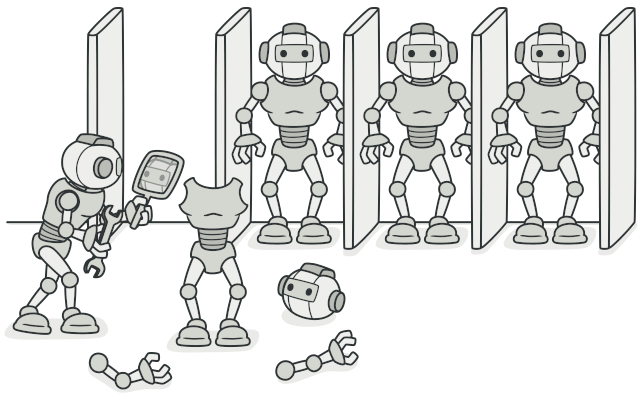
Say you have an object, and you want to create an exact copy of it. How would you do it? First, you have to create a new object of the same class. Then you have to go through all the fields of the original object and copy their values over to the new object.
Nice! But there’s a catch. Not all objects can be copied that way because some of the object’s fields may be private and not visible from outside of the object itself.

There’s one more problem with the direct approach. Since you have to know the object’s class to create a duplicate, your code becomes dependent on that class. If the extra dependency doesn’t scare you, there’s another catch. Sometimes you only know the interface that the object follows, but not its concrete class, when, for example, a parameter in a method accepts any objects that follow some interface.
Solution
The Prototype pattern delegates the cloning process to the actual objects that are being cloned. The pattern declares a common interface for all objects that support cloning. This interface lets you clone an object without coupling your code to the class of that object. Usually, such an interface contains just a single clone method.
The implementation of the clone method is very similar in all classes. The method creates an object of the current class and carries over all of the field values of the old object into the new one. You can even copy private fields because most programming languages let objects access private fields of other objects that belong to the same class.
An object that supports cloning is called a prototype. When your objects have dozens of fields and hundreds of possible configurations, cloning them might serve as an alternative to subclassing.
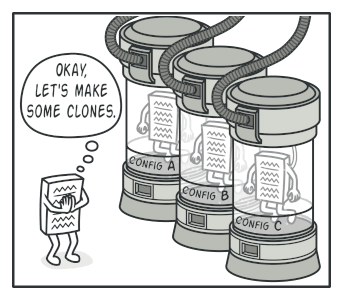
Here’s how it works: you create a set of objects, configured in various ways. When you need an object like the one you’ve configured, you just clone a prototype instead of constructing a new object from scratch.
Real-World Analogy
In real life, prototypes are used for performing various tests before starting mass production of a product. However, in this case, prototypes don’t participate in any actual production, playing a passive role instead.
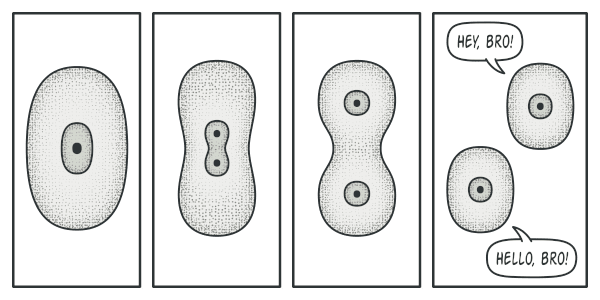
Since industrial prototypes don’t really copy themselves, a much closer analogy to the pattern is the process of mitotic cell division (biology, remember?). After mitotic division, a pair of identical cells is formed. The original cell acts as a prototype and takes an active role in creating the copy.
Structure
Basic implementation
-
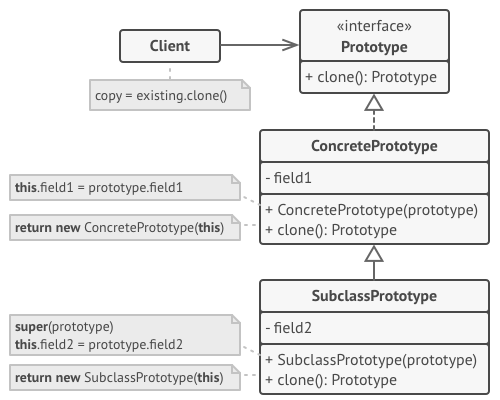
The Prototype interface declares the cloning methods. In most cases, it’s a single
clonemethod. -
The
Concrete Prototypeclass implements the cloning method. In addition to copying the original object’s data to the clone, this method may also handle some edge cases of the cloning process related to cloning linked objects, untangling recursive dependencies, etc. -
The
Clientcan produce a copy of any object that follows the prototype interface.
Prototype registry implementation
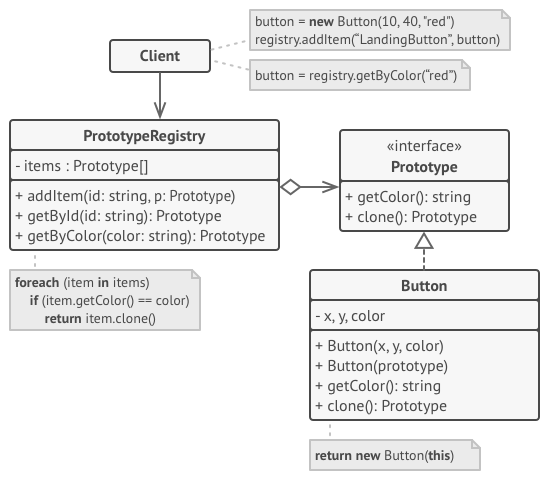
- The Prototype Registry provides an easy way to access frequently-used prototypes. It stores a set of pre-built objects that are ready to be copied. The simplest prototype registry is a
name → prototypehash map. However, if you need better search criteria than a simple name, you can build a much more robust version of the registry.
Applicability
- Use the Prototype pattern when your code shouldn’t depend on the concrete classes of objects that you need to copy.
This happens a lot when your code works with objects passed to you from 3rd-party code via some interface. The concrete classes of these objects are unknown, and you couldn’t depend on them even if you wanted to.
The Prototype pattern provides the client code with a general interface for working with all objects that support cloning. This interface makes the client code independent from the concrete classes of objects that it clones.
- Use the pattern when you want to reduce the number of subclasses that only differ in the way they initialize their respective objects.
Suppose you have a complex class that requires a laborious configuration before it can be used. There are several common ways to configure this class, and this code is scattered through your app. To reduce the duplication, you create several subclasses and put every common configuration code into their constructors. You solved the duplication problem, but now you have lots of dummy subclasses.
The Prototype pattern lets you use a set of pre-built objects configured in various ways as prototypes. Instead of instantiating a subclass that matches some configuration, the client can simply look for an appropriate prototype and clone it.
How to Implement
-
Create the prototype interface and declare the
clonemethod in it. Or just add the method to all classes of an existing class hierarchy, if you have one. -
A prototype class must define the alternative constructor that accepts an object of that class as an argument. The constructor must copy the values of all fields defined in the class from the passed object into the newly created instance. If you’re changing a subclass, you must call the parent constructor to let the superclass handle the cloning of its private fields.
If your programming language doesn’t support method overloading, you won’t be able to create a separate “prototype” constructor. Thus, copying the object’s data into the newly created clone will have to be performed within the clone method. Still, having this code in a regular constructor is safer because the resulting object is returned fully configured right after you call the new operator.
-
The cloning method usually consists of just one line: running a
newoperator with the prototypical version of the constructor. Note, that every class must explicitly override the cloning method and use its own class name along with thenewoperator. Otherwise, the cloning method may produce an object of a parent class. -
Optionally, create a centralized prototype registry to store a catalog of frequently used prototypes.
You can implement the registry as a new factory class or put it in the base prototype class with a static method for fetching the prototype. This method should search for a prototype based on search criteria that the client code passes to the method. The criteria might either be a simple string tag or a complex set of search parameters. After the appropriate prototype is found, the registry should clone it and return the copy to the client.
Finally, replace the direct calls to the subclasses’ constructors with calls to the factory method of the prototype registry.
Pros and Cons
| Nice | Bad |
|---|---|
| You can clone objects without coupling to their concrete classes. | Cloning complex objects that have circular references might be very tricky. |
| You can get rid of repeated initialization code in favor of cloning pre-built prototypes. | |
| You can produce complex objects more conveniently. | |
| You get an alternative to inheritance when dealing with configuration presets for complex objects. |
Relations with Other Patterns
-
Many designs start by using Factory Method (less complicated and more customizable via subclasses) and evolve toward Abstract Factory, Prototype, or Builder (more flexible, but more complicated).
-
Abstract Factory classes are often based on a set of Factory Methods, but you can also use Prototype to compose the methods on these classes.
-
Prototype can help when you need to save copies of Commands into history.
-
Designs that make heavy use of Composite and Decorator can often benefit from using Prototype. Applying the pattern lets you clone complex structures instead of re-constructing them from scratch.
-
Prototype isn’t based on inheritance, so it doesn’t have its drawbacks. On the other hand, Prototype requires a complicated initialization of the cloned object. Factory Method is based on inheritance but doesn’t require an initialization step.
-
Sometimes Prototype can be a simpler alternative to Memento. This works if the object, the state of which you want to store in the history, is fairly straightforward and doesn’t have links to external resources, or the links are easy to re-establish.
-
Abstract Factories, Builders and Prototypes can all be implemented as Singletons.
Conceptual Example
#include <iostream>
#include <string>
#include <unordered_map>

using std::string;

// Prototype Design Pattern
//
// Intent: Lets you copy existing objects without making your code dependent on
// their classes.

enum Type { PROTOTYPE_1 = 0, PROTOTYPE_2 };

/**
 * The example class that has cloning ability. We'll see how the values of field
 * with different types will be cloned.
 */

class Prototype {
protected:
  string prototype_name_;
  float prototype_field_;

public:
  Prototype() {}
  Prototype(string prototype_name) : prototype_name_(prototype_name) {}
  virtual ~Prototype() {}
  virtual Prototype *Clone() const = 0;
  virtual void Method(float prototype_field) {
    this->prototype_field_ = prototype_field;
    std::cout << "Call Method from " << prototype_name_
              << " with field : " << prototype_field << std::endl;
  }
};

/**
 * ConcretePrototype1 is a Sub-Class of Prototype and implement the Clone Method
 * In this example all data members of Prototype Class are in the Stack. If you
 * have pointers in your properties for ex: String* name_ ,you will need to
 * implement the Copy-Constructor to make sure you have a deep copy from the
 * clone method
 */

class ConcretePrototype1 : public Prototype {
private:
  float concrete_prototype_field1_;

public:
  ConcretePrototype1(string prototype_name, float concrete_prototype_field)
      : Prototype(prototype_name),
        concrete_prototype_field1_(concrete_prototype_field) {}

  /**
   * Notice that Clone method return a Pointer to a new ConcretePrototype1
   * replica. so, the client (who call the clone method) has the responsability
   * to free that memory. I you have smart pointer knowledge you may prefer to
   * use unique_pointer here.
   */
  Prototype *Clone() const override { return new ConcretePrototype1(*this); }
};

class ConcretePrototype2 : public Prototype {
private:
  float concrete_prototype_field2_;

public:
  ConcretePrototype2(string prototype_name, float concrete_prototype_field)
      : Prototype(prototype_name),
        concrete_prototype_field2_(concrete_prototype_field) {}
  Prototype *Clone() const override { return new ConcretePrototype2(*this); }
};

/**
 * In PrototypeFactory you have two concrete prototypes, one for each concrete
 * prototype class, so each time you want to create a bullet , you can use the
 * existing ones and clone those.
 */

class PrototypeFactory {
private:
  std::unordered_map<Type, Prototype *, std::hash<int>> prototypes_;

public:
  PrototypeFactory() {
    prototypes_[Type::PROTOTYPE_1] =
        new ConcretePrototype1("PROTOTYPE_1 ", 50.f);
    prototypes_[Type::PROTOTYPE_2] =
        new ConcretePrototype2("PROTOTYPE_2 ", 60.f);
  }

  /**
   * Be carefull of free all memory allocated. Again, if you have smart pointers
   * knowelege will be better to use it here.
   */

  ~PrototypeFactory() {
    delete prototypes_[Type::PROTOTYPE_1];
    delete prototypes_[Type::PROTOTYPE_2];
  }

  /**
   * Notice here that you just need to specify the type of the prototype you
   * want and the method will create from the object with this type.
   */
  Prototype *CreatePrototype(Type type) { return prototypes_[type]->Clone(); }
};

void Client(PrototypeFactory &prototype_factory) {
  std::cout << "Let's create a Prototype 1\n";

  Prototype *prototype = prototype_factory.CreatePrototype(Type::PROTOTYPE_1);
  prototype->Method(90);
  delete prototype;

  std::cout << "\n";

  std::cout << "Let's create a Prototype 2 \n";

  prototype = prototype_factory.CreatePrototype(Type::PROTOTYPE_2);
  prototype->Method(10);

  delete prototype;
}

int main() {
  PrototypeFactory *prototype_factory = new PrototypeFactory();
  Client(*prototype_factory);
  delete prototype_factory;

  return 0;
}